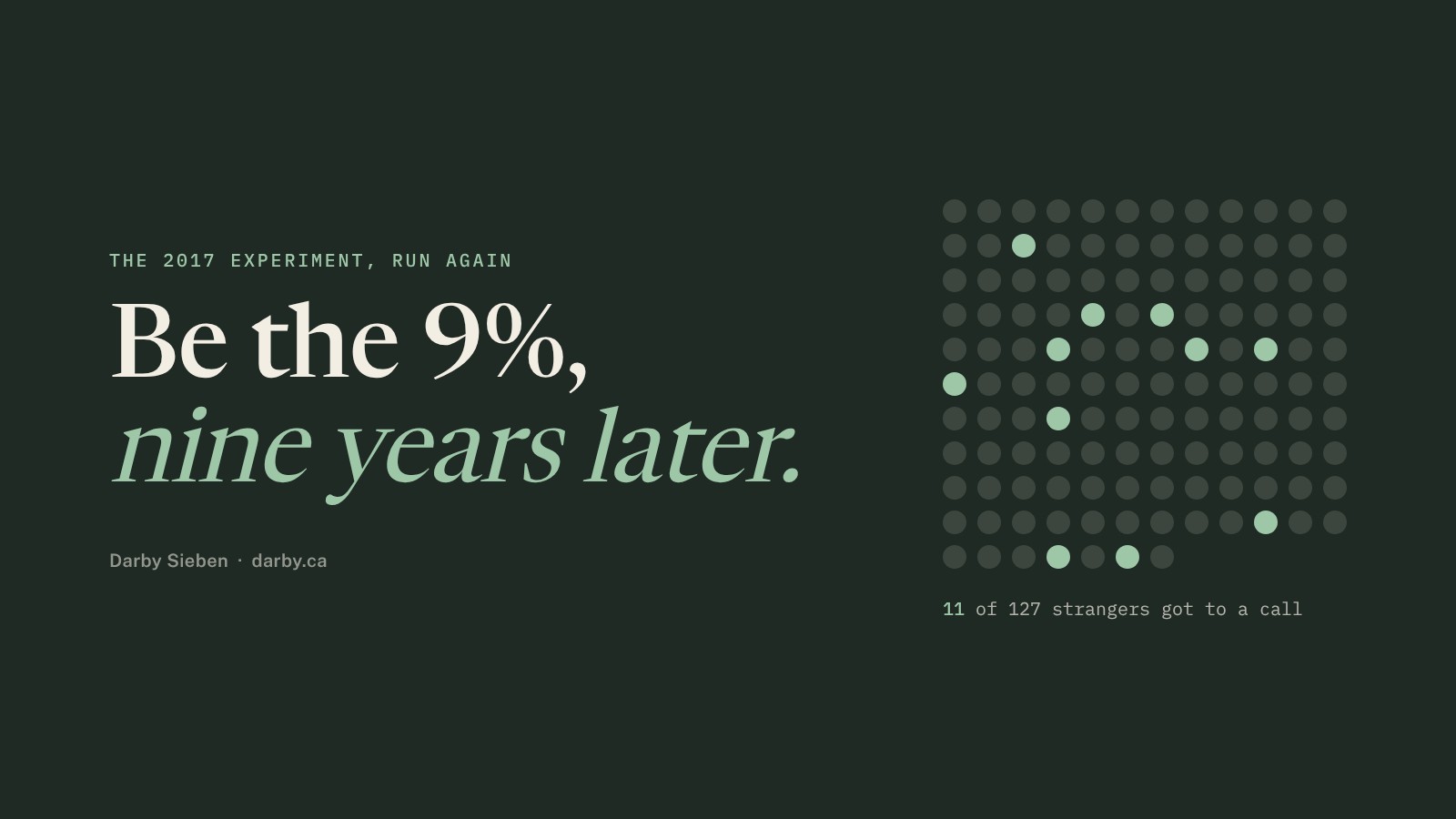
Nine years ago I published a small experiment. For a year I asked every stranger who sent me a LinkedIn request one question: what's the motivation for the request? Half never answered. Forty percent wanted to expand their network. One percent lectured me on how to use LinkedIn. Nine percent had a real reason, and those turned into great connections and real business.
The call to action was simple. Be the 9%. Tell me what you want, why and next steps.
The experiment ended after a year. The question didn't. I've asked it of every stranger who wanted to connect ever since.
A lot has changed since 2017. LinkedIn is busier than it's ever been. AI can write a connection note in seconds, and there are tools that will run your LinkedIn for you. So I ran the experiment again.
What surprised me: the number is still 9%. What changed is where the 9% sits in the funnel, and I think that's a change for the better.
How I ran it this time
The question is the same one I asked in 2017. What changed is the plumbing.
Every morning an AI agent reads my pending LinkedIn invitations and sends me a digest. It looks up each person and their company. It drafts my standard reply: "I'm not sure if we've met or if our paths have crossed. What's the motivation behind your request?" I read the digest over coffee and reply with what to send, keep or delete. Founders raising money now get one extra step: send me your deck first.
The numbers below are as of November 20, 2026. They cover 127 LinkedIn invitations from April to November 2026, counted once per person.
The 2026 results
Of the 127 people who asked to connect, 79 got my question. The rest were obvious sales pitches I deleted, or people I accepted because I knew them. Here's how the 72 who had at least two weeks to answer compare with 2017.
| Response | 2017 | 2026 |
|---|---|---|
| No response | 50% | 40% |
| Expanding my network | 40% | 26% |
| Legitimately have a reason | 9% | 33% |
| WTF are you serious | 1% | 0% |
The good news first. Nobody lectured me this year, and a third of the people who answered had a real reason. That's almost four times 2017.
But it's not a clean comparison. My morning agent screens harder than I did by hand in 2017. Obvious sellers never get the question, and founders get a deck request instead. So the 33% is partly a better crowd and partly a better filter.
Forty percent still click Connect and never answer an easy question. Some things don't change.
What changed in nine years
The 9% moved down the funnel
In 2017 the 9% were the people with a good reason. This year I tracked further, all the way to a conversation:
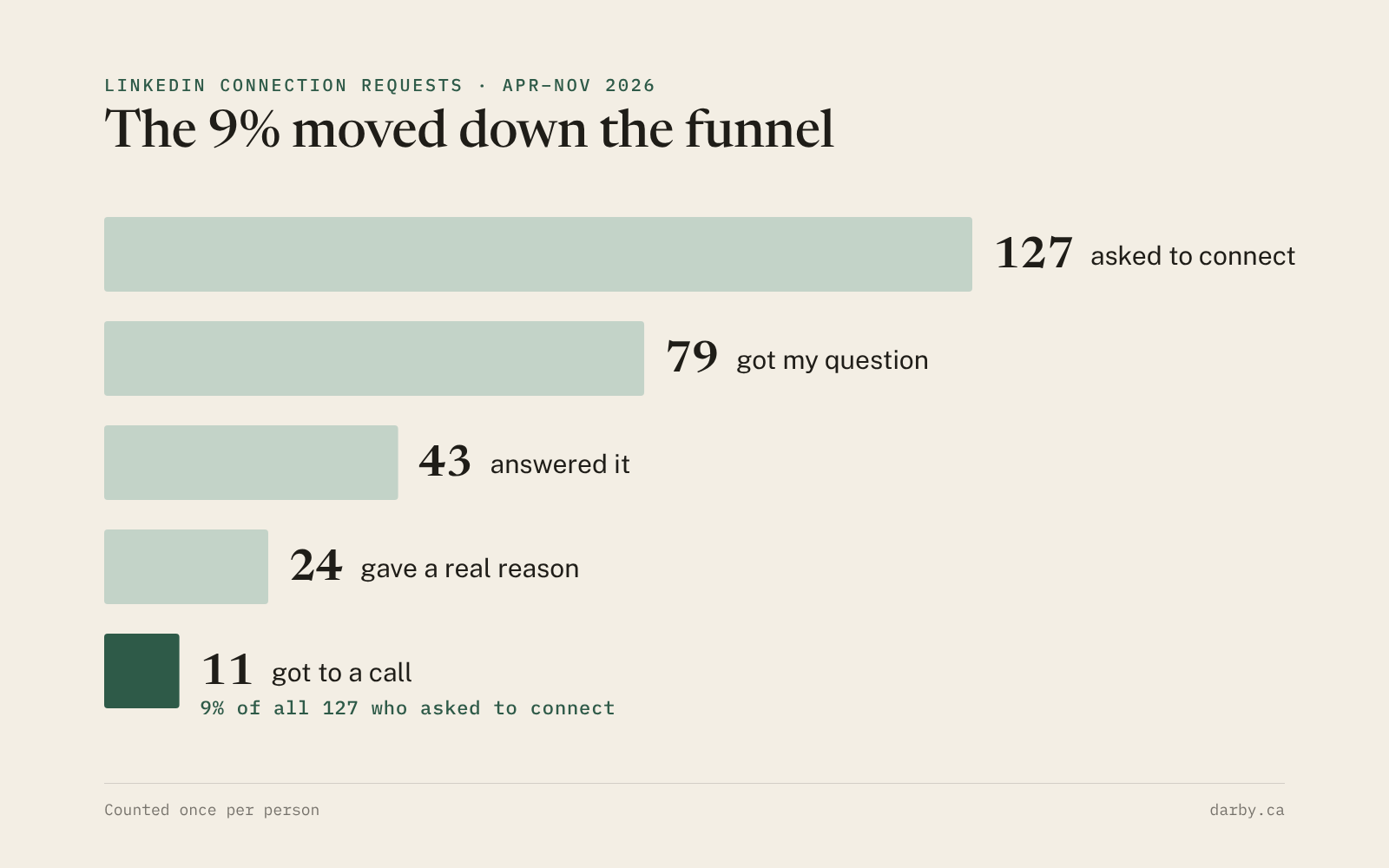
Eleven of 127 is 9%. Nine years, an AI agent and a lot more noise later, the share of strangers who end up worth my time is the same number.
A note still matters
I expected AI to kill the personal note. Anyone can generate a warm, specific-sounding note in seconds, so I assumed it no longer meant anything. I was wrong.
- A note that stated a reason: 64% gave me a real reason when I asked
- Any note: 50%
- No note: 28%
A note roughly doubles your odds. A note that says what you want does even better. That's the 2017 advice, holding up.
Who the 9% are now
The 9% weren't one type of person. They were founders raising money, funds looking for investors, suppliers with a clear offer and people networking with a specific goal. What they shared wasn't a job title. They told me what they wanted and why. The people outside the 9% changed too. In 2017 "expanding my network" mostly meant collecting connections. In 2026 it mostly means selling something.
The AI superconnector
I also tracked a second channel: Boardy, an AI superconnector. Since December 2025 it has proposed 121 introductions to me by email. I accept or decline each one, and both sides opt in before the intro happens.
Boardy is "Be the 9%" turned into a product. Every introduction arrives with a reason and a benefit for both sides, written by an AI that has talked to each of you.
Full disclosure: I'm a small investor in the company behind it, which is part of why I track it so closely.
| Boardy | ||
|---|---|---|
| People coming in | 127 invitations | 121 proposals |
| I engaged | 79 asked why | 67 accepted |
| Got to a call | 11 (9%) | 19 (16%) |
The superconnector gets me to a call nearly twice as often.
Nine years later, here are my conclusions
#1 – Still true: say what you want, why and next steps, right away. A note with a reason more than doubles your odds of getting a real conversation. Be the 9%.
#2 – AI lets you reach more people, faster. Without a real reason, that's just more noise and more wasted time, yours and theirs. Let AI help with the how. Be thoughtful about the why.
#3 – If you're selling, lead with what's in it for me. The sellers who did made the 9%. Most didn't.
The 9% didn't shrink and it didn't grow. What changed is who's in it and how much noise sits around it.
I'll keep asking the same question. It's still the fastest filter I have.